Sunday, November 3, 2013

on the move South, short stop in Carmel, Ind., worlds largest wind chime.

We are off, heading south to warmer climates and with the Tropical Storm season coming to an end we can start moving. First a few Aha moments. I was surprised that there was so little color in Indiana. It seems the further south we went the colors just drained from the trees. Short look up and here is the reason.
During winter, there is not enough light or water for photosynthesis. The trees will rest, and live off the food they stored during the summer. They begin to shut down their food-making factories. The green chlorophyll disappears from the leaves. As the bright green fades away, we begin to see yellow and orange colors. Small amounts of these colors have been in the leaves all along. We just can't see them in the summer, because they are covered up by the green chlorophyll.
autumn leaves sceneThe bright reds and purples we see in leaves are made mostly in the fall. In some trees, like maples, glucose is trapped in the leaves after photosynthesis stops. Sunlight and the cool nights of autumn cause the leaves turn this glucose into a red color. The brown color of trees like oaks is made from wastes left in the leaves.
It is the combination of all these things that make the beautiful fall foliage colors we enjoy each year.

We made a stop in Carmel, Ind and a visit with Meghan. We also stopped to see the worlds larges wind chime. Over night now in Texarkana and tomorrow we should back in Kemah. 
We had a short visit with Meghan and she took us on a tour of Indianapolis. There are some fascinating buildings, here are a few pictures
Two commercial buildings in the 700 block of the avenue are noteworthy for their original Italianate designs. 706-710 and 707-711 are brick c. 1875 Italianates. Both retain original stone arcaded storefronts. Further up the avenue past restaurants, galleries, and drinking establishments, 858-868 is an Art Deco masterpiece. Local architects Rubush & Hunter designed this large complex for the Coca-Cola Bottling Company in 1931. The gleaming white glazed terra cotta exterior is ornamented with chevrons, sunbursts, and stylized pilasters in relief.


Further up, at New Jersey and Massachusetts, is a unique architectural wonder, the headquarters of the Indianapolis Ancient Arabic Order, Nobles of the Mystic Shrine — the Murat Shrine Building. Oscar Bohlen of D.A. Bohlen & Sons designed this building in 1909. Bands of tan and brown brick, Moorish arches, onion domes, and a 208’ minaret tower make this landmark stand out on the Indianapolis skyline. In 1922, architects Rubush & Hunter designed a north addition with Egyptian Room, inspired by the recent find of King Tutankhamun’s Tomb. Across the street is the German social club, The Athenaeum (Das Deutsche Haus).


We had a wonderful dinner at the Rathskeller 


The Indiana World War Memorial Plaza is an urban feature located in Indianapolis, Indiana, originally built to honor the veterans of World War I.[3] The five-city-block plaza was conceived in 1919 as a location for the national headquarters of the American Legion and a memorial to the state's and nation's veterans. At the north end of the plaza is the American Legion Mall, which is the site of the administration buildings of the Legion, as well as a memorial cenotaph. South of that is the Veterans Memorial Plaza with its obelisk.
The Indiana Soldiers and Sailors Monument is a 284 ft 6 in (86.72 m)-tall neoclassical monument located on Monument Circle in the center ofIndianapolis. It was designed by German architect Bruno Schmitz and completed in 1901.
The Monument was erected to honor Hoosiers who were veterans of the American Revolution, territorial conflicts that partially led up to the War of 1812, the Mexican-American War, the US Civil War, and the Spanish American War. In addition to its external commemorative statuary and fountains (made primarily of oolitic limestone and bronze), the basement of the monument contains the Colonel Eli Lilly Civil War Museum, a museum of Indiana history during the American Civil War.


crossing into Missouri
With the help of a bucket truck, a 100-foot (30 m) tall oak tree, his son David, and numerous friends, the chime was erected on site from prepared components in front of approximately 100 onlookers. The chime is dedicated to Ranaga's late father, Ignatz Farbiarz, a Holocaust Survivor.
The six metal pipes are tuned in an Oriental pentatonic scale, like the black keys on a piano, with the longest and shortest tubes emitting notes an octave apart. The deepest toned tube is 20 feet (6.1 m) long and "sounds like a combination Cathedral Bell, Tibetan Singing Bowl and Jet engine." The shortest is 14 feet (4.3 m) and has a rich Cathedral-like sound. The overall length of the chime is 35 feet 10 inches (10.92 m), easily beating the previous record of 16 feet 8 inches (5.08 m)
The instrument is made from four-inch (102 mm) diameter, thick-walled aluminum tubing. The total weight of the chime is 653 pounds with the musical tubing alone weighing 310 pounds. The 6-foot (1.8 m) by 8-foot (2.4 m) wooden pyramidal shaped top weighs 225 pounds. The center hung circular wood knocker is 3' 6" in diameter and weighs 64 pounds. A 4-foot (1.2 m) long by 2-foot (0.61 m) wide Celestial Wind Dervish which Ranaga makes out of recycled local and imported woods is used as the windcatcher and weighs 18 pounds. The down rods and miscellaneous hardware weigh 36 pounds. Ranaga calls it the “Wind Chime of Mass Distraction” (WMD) because it is made with the same size and grade aluminum sought by the weapons inspectors in Iraq.
Posted by Picasa

Wednesday, October 16, 2013

Fall in Michigan and Knitting

Wednesday 10/16
an apology to everyone who gets an email there is a new post.  Honest when I checked in the Spring Lake Library there were photos.. what can I say. 
I love fall... I know there is plenty of color in Texas, all green with bright flowers everywhere, nevertheless there is something to be said for a crisp fall day the crunch crackle of leaves underfoot, a tang in the breeze, dancing colors twirling along streets, sidewalks, and air. This morning we woke to gray skies, light cold drizzle, wind pulling leaves from the trees filling the air with dancing fall colors.
It is finally fall temperatures here the rest of the week  falling to the 40's and 30's and the prospect of the first hard frost. Yippee
Of course by the time we leave I will be aching for warm sun and 80 degrees

Saturday (10/12) I went to Grand Rapids and the Fulton Street Market then just some wandering and general... I haunted the remember places that were part of everyday life before we left. I stopped at Schuler's books on 28th for Quiche, then wandered up and down Plainfield Ave perusing quilt shops. It was fun and while there are new buildings, most of the old ones are still there but rearranged. I renewed acquaintance with some vendors at the market and came home totes filled with goodies. 
new knitting project. I am making a Fair Isle Cardigan
for myself , this is the first sleeve


I love spotting the first leaf on a branch turning colors
I have discovered lots of animal tracks in the front yard


I can successfully knit a hat, that looks like a hat
However I need to find someone with a large head to
wear it  ;0

I love seeing the pine trees here filled with pine cones
lichen on the trees means the air around here
is clean.. a good sign

Posted by Picasa

Friday, October 4, 2013

World Bird Santuary October 3rd 2013

We finally made it to the sanctuary  with beautiful weather, two hours went by before we realized it. Tom was just as enthralled as I was by these magnificent birds. If you are even within a hundred miles, please stop.. check out their web site, or blog. http://www.worldbirdsanctuary.org   The World Bird Sanctuary rests peacefully on 305 acres of Missouri hardwood forest, next door to Lone Elk County Park and Chubb Trail. We are open daily from 8am - 5pm, and closed only on Thanksgiving and Christmas. Free entry and parking. Walter C. Crawford, Jr., World Bird Sanctuary Founder and Executive Director, started the important work of rehabilitating and releasing birds of prey over 35 years ago. Preserving, protecting and helping Bald Eagles has been a core focus of his life's work. In 2010/2011, we followed one eagle's story – a testament to the commitment of Walter and his staff to the mission of World Bird Sanctuary.
The sanctuary is up in the hills, in a very wooded area. Your can
hear wild birds off in the trees. There are feeders set out for wild birds

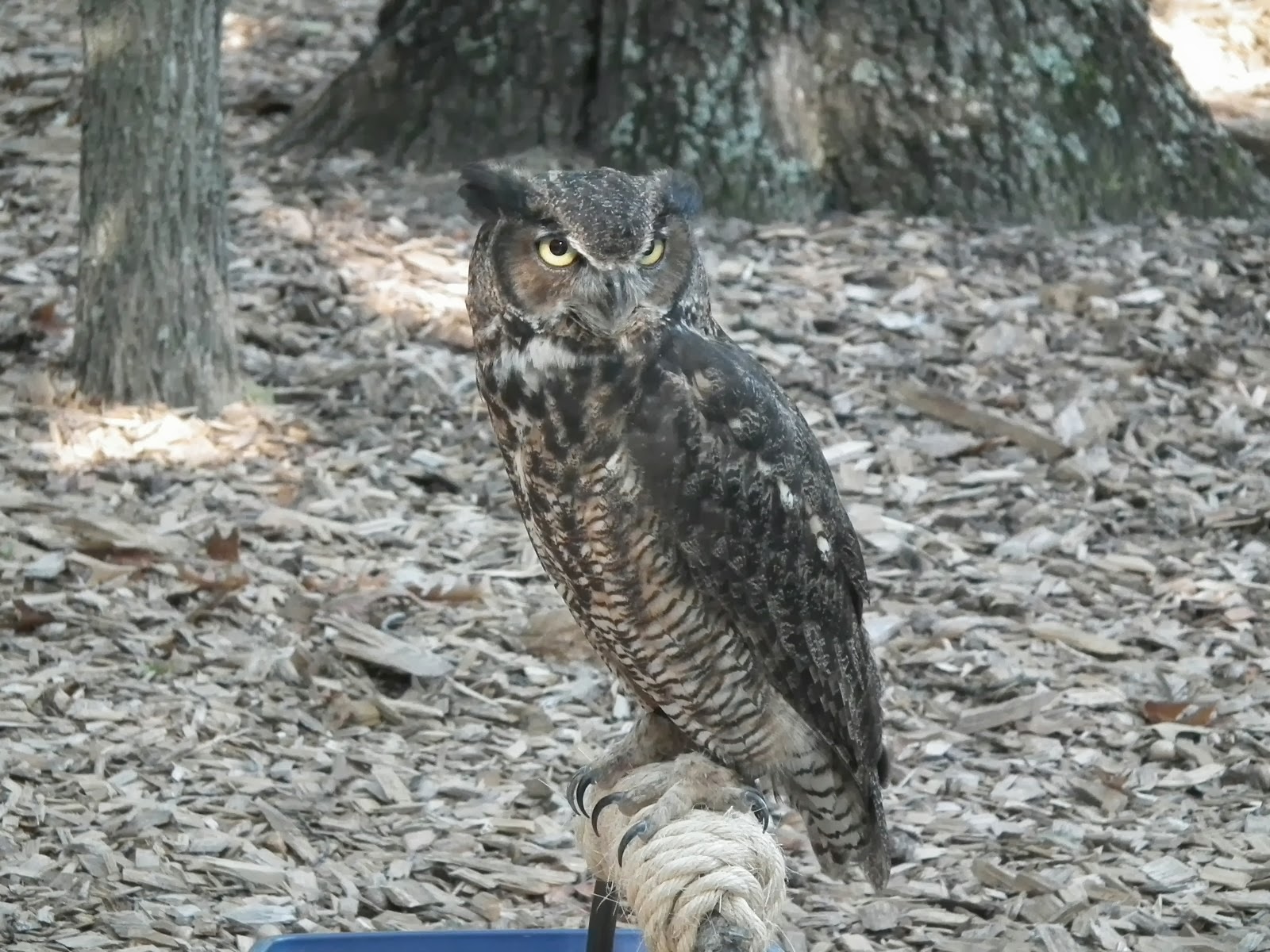
Eurasian Eagle Owl

similar to the great horned owl, but much larger; prominent ear tufts are usually laid back; streaked breast, mottled brownish feathers; some have orangish-brown feathers on the face, underparts, wings, and back; orange-yellow or deep fiery orange eyes; adults and juveniles similar in appearance

Liberty

Liberty, a male bald eagle, arrived at the Florida Audubon Society's rehabilitation center in the summer of 1992, as a juvenile, with a fractured coracoid (similar to a human collar bone). After healing, he was banded and released at the Merritt Island, Florida, National Wildlife Refuge on 10/30/92. Three weeks later he was found in St. Augustine, Florida, with a dislocated humerus (shoulder) and permanent retinal damage to both eyes. It is believed he was hit by a car. After healing, Liberty was transferred to the World Bird Sanctuary, where he became a featured educational bird. In his travels he has helped to educate thousands of audiences about the amazing success story of our national symbol. His calm and relaxed attitude, along with his regal bearing, has made him a popular favorite with handlers and audiences alike

Red-Tailed Hawk sturdy looking bird with short, rounded wings and fanned tails; adults have mottled chocolate-colored backs with lighter brown shoulder patches; the tail is brick red, from which they originally derived their name; the breast is white with a dark belly band across the abdomen; however, some birds are so light as to appear albino; immature birds are heavily banded (vertically) on the breast and chest and have a greyish to brownish tail with black bands; immature birds develop the adult coloration after the first year; juveniles' eye color also changes during this period from a yellowish brown to a dark brown at maturity


Hooded Vulture

Augur BuzzardKeeoo

Keeoo was hatched 3/28/92 at the the World Bird Sanctuary/ She was named for the distinctive call of the Augur Buzzard. Over the years Keeoo has participated in education programs at Sea World of Ohio, Grant's Farm, Forth Worth Zoo, Milwaukee County Zoo, and Busch Gardens Williamsburg. Keeoo currently resides at the World Bird Sanctuary, where she has helps to educate thousands of visitors every year. Your adoption fee will help feed, house and care for Keeoo in the coming year.


Posted by Picasau