Saturday, February 9, 2013

Glass Window Bridge, Moving down the coast of Eleuthera

Wednesday night we were anchored in Goulding Cay. Thursday Morning wind was less than 10 kts, and no waves to speak  we decided to take a ride and photograph  Glass Window Bridge.  Today it's a man made bridged breach at the Eleuthera Islands narrowest point. On the Ocean side, where the reef is not continuous, waves gnawed at this point and finally broke the natural bridge in two.  A rogue wave in 1991 knocked the bridge seven feet to the west but it was finally repaired. You can see where there is stress around the base of the bridge.

 Eleuthera is miles of rugged imposing bluffs, pock marked with caves and deep crevasses craved into the weeping limestone. These bluffs offer shelter from wind, but make landing a dingy rather a daunting affair. We admired the bridge from afar watching waves crash in from the Atlantic side.  Motoring back towards Cool Hand we did spy a beach and landed there for me to gather some shells and marvel at the worn rock formations. Tom disappeared, coming back to lead the way to the other side, just a short hike and a spectacular view of the Atlantic Ocean.  Back in the dingy we arrived at Cool Hand just as the wind started to pick up. By the time we weighed anchor the winds were topping 15kts and the waves were right on our nose. Tom had taken some of the weight out of our bow but riding a bucking rocking horse boat for 7 hours at 3.5kts was neither comfortable nor enjoyable. We finally decided to duck into Alabaster Bay, a wide cove that could give us some protection from the wind. We also were interested in the Coca di Mama resort which Active Captain gave good reviews. Unfortunately no one was around, but the site was quiet and around mid- night the wind die back so we both slept fairly well.
our  routre
This wall is at least 5' high and the waves -  crashed over
with ease


brings all kinds of thoughts to mind - nature is wonderfully
humorous
Thousands of bits and pieces filled the hole in the
water warm limestone


stone walk way to the Atlantic


The Atlantic side of the island the water is a deep blue
The west side of the island the water is more aqua
Cool Hand at Anchor
a hammock and a cave

stopping place for the night
Posted by Picasa

Friday, February 8, 2013

Moving on - well stuck for awhile


The lesser of two evils and going aground…
We woke to the roosters crowing and smooth seas and no wind. There are two ways to get to the western edge of Eleuthera Island from where we were. There is a small passage about 10 miles long between Eleuthera and Current Island called Current cut.  It can have a current of 6 to 8 knots and you have to time your passage to coincide with the tide. Most of the passage is deep water but – as with everything here – there is a -but – at the exit there is a shallow spot and it your running lickety split out of there it could be interesting scooting around it.
OR
You can go to the end of Current Island and run the passage between it and the Pimlico Islands. Now here is where the color of water comes into play. Every book, guide, map we have says to pay attention to the color of the water.  Dark blue means deep water, but it could mean big rock, clear bright blue water is good, you can see the white sand bottom but the lighter the blue the closer the bottom. We found out Green water, like water downed pea soup or green Kool-Aid mixed with squirt is SHALLOW. We were suddenly in less than 6’ of water. We draw 4.5’ and then we were brushing bottom, then we were stopped.  The tide was going out so it would only get shallower, so we dropped anchor and waited.
It was a very pretty spot, no fishing boats buzzing us; I went up to the front of the boat to read and Tom took the dingy off the davits to lessen the load in the back. I look over the edge and noticed that our anchor was on the starboard side instead of in front. We were moving.
We started up the engine and finally backed ourselves to deeper water;  got ourselves water color orientated and finally got through to the other side. Next stop Glass Window Bridge and our anchor spot for the night. The wind has picked up and air cooled down. We are anchored about 50’ from shore and a nice beach. Tomorrow we are going to go exploring before we more on.
Always an adventure
a view from our temporary stop


finally we passed the point.
neat cloud shape
Glass Window Bridge
Sunset and the roosters are crowing


Posted by Picasa

Arriving at Spanish Wells

At note about the Eleuthera chain of islands- they are not a prime “tourist or boaters” destination. I think that intrigued both Tom and I after Nassau. There are towns that dot the island and Spanish Wells is considered the Lobster Capital of the Bahamas. We decided to start there and work our way south and then to the Exumas.
 There were two Catamarans anchored close to the harbor entrance when we arrived, but we chose a place a litter further down and out of the path of fishing boats. We settled in for the night the sky studded with stars and roosters crowing in the distance. Yep roosters… dozens and dozens of roosters that do not seem to know the difference between sun rise and sunset so …. They crow for both.
On Tuesday we took the dingy into the harbor and the town Spanish Wells. There are two Islands that are linked by a bridge Russell on the south/West side and Spanish Wells on the North/east side (see Map). You can rent a golf cart and take the tour of the island. The first thing that stuck Tom and I; no trash, the streets were clean, picked up. There were crews out doing road clean up and trimming the dead limbs back. The homes are colorful but coordinated, the owners taking pride in their property. Houses have a base of white with bright colors to accent. Since the yards are rock (the island is limestone) there are no green lush lawns. Instead there are colorful dracaena plants, flowers hibiscus, bougainvillea, and palms. You also notice that they need rain. Everything here is dry and showing the stress from the lack of moisture. We drove the entire length of the island then went back to visit a few special places.
First stop was the post office; I mailed a letter to the states. The Postmistress said the mail boat would be in on Wednesday and she would make sure it was on that boat BUT… it was going to Nassau and she had no idea how long it would stay there.
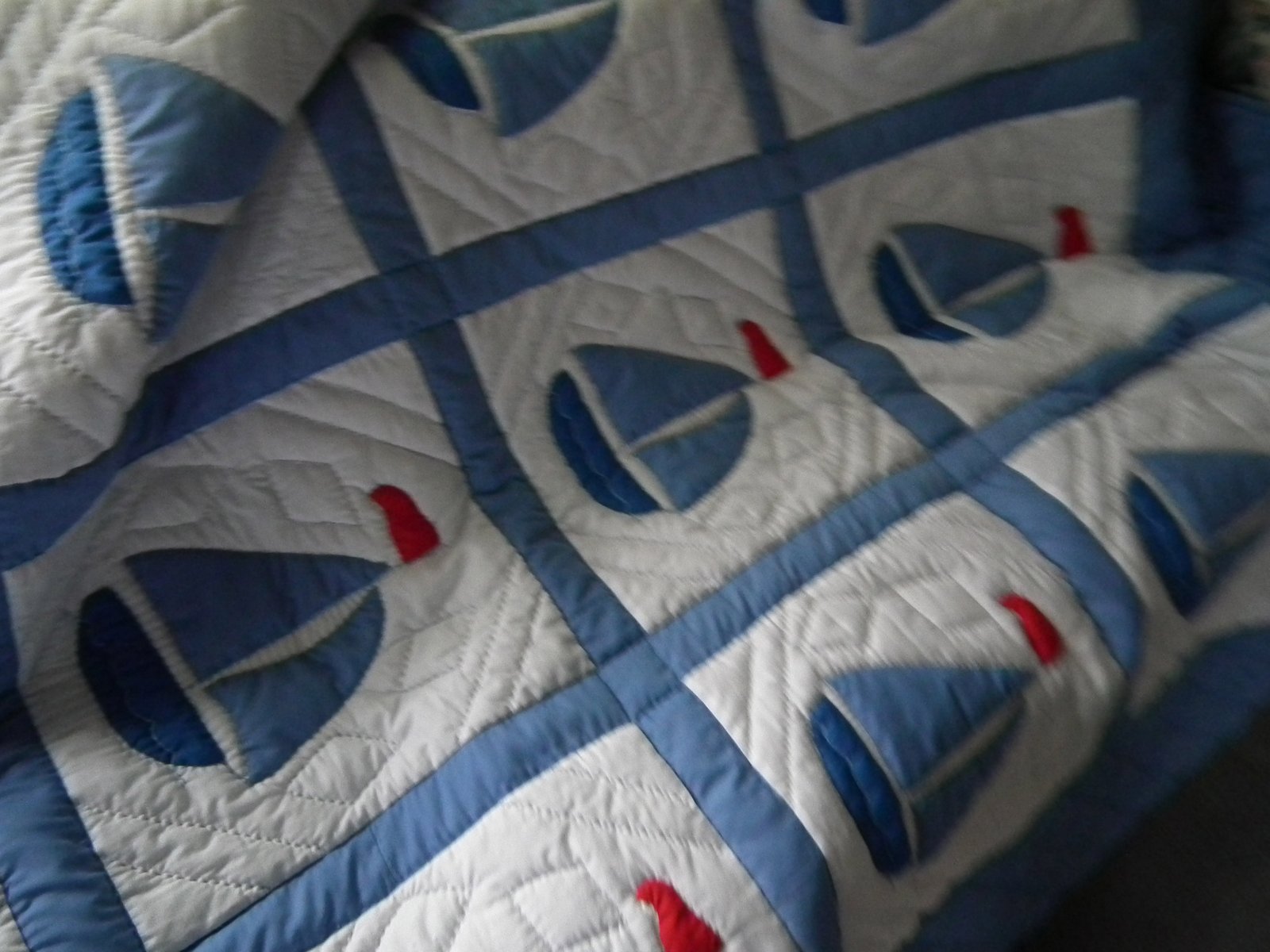
Next stop was the Quilt Shop This was a small house – just one room really – I peeked in side and there were boxes with material, miscellaneous sewing supplies and a quilt frame with a quilt on it. A woman from next door Ms. Cecile Dunnam came out and told me to go on in. The quilt they were making was for a local boy who was leaving for school. She invited me into her home and showed me a sail boat quilt she just finished and we had a delightful conversation about material and quilting. She advised that the variety store across the way had the Batik material made on Andros Island, so after saying good bye we 

went and I purchase some material in hopes that Meghan (hint hint) will make us a quilt. They suggested a restaurant for lunch, then a walk on the beach where the sand really does have a pink/peach cast to it, and then we returned the golf cart.
We both agreed that we would come back to Spanish Wells.  On the Atlantic side of this chain we could go to Harbor Island and a bigger Pink Sand beach, Coral reef and well not much else until you get all the way down to the southern end. If a storm came in from the east we would have no protection. So we have decided to take the inside track. Early to bed, tomorrow we move. 


The Water is so clear that is looks like it is floating
Sunrise  

Great Heron 
Haven't identified this one yet - any guesses

Ms Cecile's Quilt all hand made
The material that I bought for my Island Quilt
The beaches have a pink cast from crushed  coral and shells


Spanish Wells is considered the Lobster Capital of the Island
I found a sand dollar on the beach


my treasure
Sunset and the roosters crowing
Posted by Picasa

leaving Nassau for Eleuthera

Leaving Nassau - Monday, February 4th
At last we have good weather. Well we have reasonable winds (in the wrong direction) and semi-reasonable waves (3’ to 4’), time to leave. Quite frankly several ocean going cruise ships had arrived releasing a mass of tourist on to the island and we were tired of all the noise and bouncing around in our slip.
We cleared the harbor and knew we would have to motor the entire journey. We were taking waves on the nose water washing up over the front hatch, which I did not dog down tight enough, and we left the new vents open. After drying things off I went back in the cockpit to get splashed in the back by a rogue wave. I finally gave up trying to do any cross stitch and settled for reading. I did manage sandwiches for lunch and finally around 3:00 we were choosing a site to drop anchor.

Finally we  left our slip 
You can see a cruise ship between the spans of the bridge
just a small cotage


The sun tried to cut through the clouds
we had wind on the nose - no sailing today


Saturday, February 2, 2013

Flamingos of Ardastra

The big reason for going to the zoo was to see the world famous Marching Flamingos. It really is more of a herding a flock of flightless birds with some amusing outcomes. 
The show is informative and the birds are a hoot to watch. 
In the 1950s the Bahamian government brought flamingoes with the intention of breeding, as they had become rare there. In 1982 the gardens were bought by Bahamian, Mr. Norman Solomon, who started the first Bahamian zoo. Best known for its flamingos, the zoo now has about 300 animals.

Like all flamingos, it lays a single chalky white egg on a mud mound, between May and August; incubation until hatching takes from 28 to 32 days; both parents brood the young for a period of up to 6 years when they reach sexual maturity. Their life expectancy of 40 years is one of the longest in birds.
Adult American Flamingo's are smaller on average than Greater Flamingoes but are the largest flamingos in the Americas. They measure from 120 to 145 cm (47 to 57 in) tall. The males weigh an average of 2.8 kg (6.2 lb), while females average 2.2 kg (4.9 lb). Most of its plumage is pink, giving rise to its earlier name of Rosy Flamingo and differentiating adults from the much paler Greater Flamingo. The wing coverts are red, and the primary and secondary flight feathers are black. The bill is pink and white with a restricted black tip, and the legs are entirely pink. The call is a goose-like honking.


oops Tom and the Salmon Crested Cockatoo

some birds were always out of  formation

Posted by Picasa