Tuesday, October 2, 2012

More from inside the National Natural History Museum

When you enter the Museum there is a large Elephant and you can look up to see all the floors and signs with their exhibits. Then you turn and see the dinosaur skeletons. Everything is well lit, there are guides and guards everywhere, the laughter of children, and adults captivated at every turn


Copper, White Pine Mine, Ontonagon County Michigan
This sheet of nearly pure copper was once sandwiched between layers of shale. It crumpled when miners blasted the rock. Bits of dark shale remain attached to the copper, which also bears the imprint of water ripples preserved in the shale.
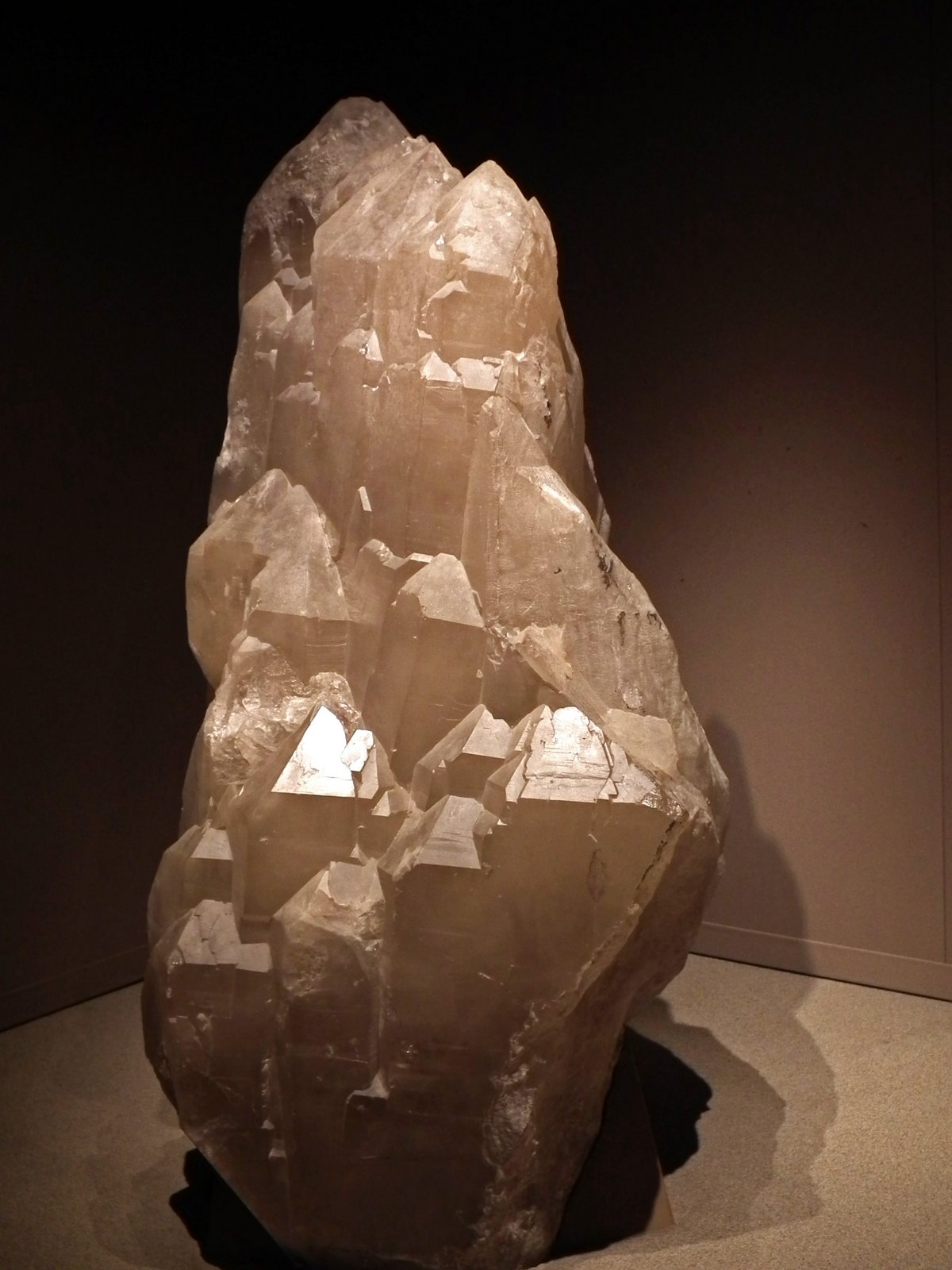
Quartz   Otjua mine, Karibib, Namibia
Several crystals grew together and from this 590-kg – 1300lb quartz giant. Each crystal has the six sided pencil shape typical of quartz
The Hope Diamond (picture does not do it justice)
The Cullinan Blue Diamond Necklace/Brooch total weight of 5.57 carats
Sandstone Concretion – Fontainebleau, France
This natural sandstone formation is made of quartz – the same mineral as the giant crystal. Here, tiny crystals of quartz cemented together grains of quartz sand

The Eocene’s Big Bird Diatryma Steini, Cast
Early Eocene (55-50 Million years ago) Wyoming
Fossil beaver in the natural cast of its own burrow
23 million years old - Nebraska
Douglas fir about 12 million years old
Oak about 12 million years old
Posted by Picasa

Still walking around National Mall - Natural History Museum

As you can see we just did not get any sunshine at all. I thought that we would go see the Sculpture Garden but both of us were hungry and the Natural History Museum had the Fossil Cafe so we went in and were immediately captivated by the exhibits.
There was an exhibit of Photos 2011 Winners of natures Best Photograph - They were spectacular  Printed and set behind glass they are worth going to see.

Highly Honored: Animal Antics
Lion
Panthera leo
Madikwe Game Reserve, North West Province, South Africa
By Gerry Van der Walt, Randburg, South Africa
Although lions drink regularly when water is available, they are capable of obtaining their moisture requirements from prey and even plants, and thus can survive in very dry environments. Medium- to large-sized antelopes, zebra, and wildebeest are the bulk of their prey, but lions will take almost any animal, from rodents to an elephant. They also scavenge, stealing kills from other predators.
"In the Madikwe Game Reserve we found three lions that had just killed an impala in a muddy waterhole. When we returned to the area later that afternoon, we found this lion sitting on a termite hill. With the light fading, I had a chance to fire off a few quick images before the youngster disappeared into a thicket."—GVdW
Highly Honored: Birds
Great Gray Owl
Strix nebulosa
Near Vaala, Finland
By Igor Shilokhvost, St. Petersburg, Russia
Great Gray Owls inhabit coniferous forests of the Northern Hemisphere; they tend not to migrate but will leave their territories if their food supply runs short. The reclusive owls hunt equally well both day and night, as they have both excellent hearing and vision. The feathers of their facial disks direct sound toward their ears; their soft feathers keep their flight silent; and they can turn their heads three quarters of a circle (270 degrees).
"June in Finland is called the ‘white nights time.’ Watching and photographing owls during the night, when it is as bright as daytime, is a very unique experience. This female owl was seen caring for her chicks— not only bringing food, but also shielding and warming them with her wings. For a brief moment, both the adult and one chick looked right in my direction."
Highly Honored: Birds
European Shag
Phalacrocorax aristotelis
Hornøya, Norway
By Kjetil Schjølberg Stjørdal, Norway
European Shags are found along rocky, marine coastlines and islands. Their preferred foraging grounds are clear, protected waters, such as bays or coastal channels. Occasionally a phenomenon known as a 'wreck' occurs, when adverse weather conditions drift birds inland, where they become stranded in unusual habitats. This results in very high mortality for immature birds. European Shags hunt singly, generally diving to pursue their prey under water. They perform a distinctive "leap" before their dives.
"In late March, when the seabirds arrive at their breeding grounds in Arctic Norway, the weather can be extremely harsh. I wanted to show that shags were well-adapted to these conditions. The intense appearance of the shag has led to its presence in Norwegian coastal mythology. This bird posed long enough for me to get the image even though all the buttons on my camera gear had frozen—except the shutter."—KS
Roseate Spoonbills
Platalea ajaja
Smith Oaks Rookery, High Island, Texas, USA
By Michael Rosenbaum, Delray Beach, Florida, USA
A social bird, the spoonbill lives in large colonies with other wading birds. Its feathers get their rosy pink color from the crustaceans in their diet. While foraging for food in shallow water, the nearly three-foot-tall bird swings its head back and forth, using its long, flat bill to sift up small fish, shrimp, amphibians, mollusks, snails, and insects. Thousands of spoonbills roost and nest at the Smith Oaks sanctuary, off the northeast coast of Texas.
"When I visited the Smith Oaks Rookery for the first time, I spent several mornings photographing spoonbills in overcast and foggy conditions. In this photo the bird coming in to land was being warned off by a spoonbill already occupying the tree branch. The interaction may be two birds engaged in combat, but the soft color and graceful lines of the composition make the behavior appear almost like a kiss."—MR

Conservation Photographer of the Year
Polar Bears
Ursus maritimus
Manitoba, Canada
By Thomas D. Mangelsen, Jackson, Wyoming, USA
"In a bed of soft snow and frost-dusted spruce, a polar bear family takes an afternoon nap cuddled up together. After being woken up by its squirming, sleepy sibling, this polar bear cub is wide-awake and ready to play. Greeting the wintry world, he waves his soft paw from the warm haven of his mother's arms."—DB
Highly Honored: Animal Antics
Emperor Penguins
Aptenodytes forsteri
Snow Hill Island, Antarctica
By Thomas Kokta, Issaquah, Washington, USA
Emperor Penguins use a complex set of vocalizations that are critical in individual recognition between mates, parents, and offspring. Aside from the mate attraction and recognition calls, emperors use contact calls to maintain contact with other penguins during feeding or travel. As the species has no fixed nest sites that individuals can use to locate their own partner or chick, they must rely on vocal calls for identification. Chicks use a frequency-modulated whistle to beg for food and to contact a parent.
"Photographing the 'white' areas in polar regions where Emperor Penguins live on the ice and snow is my passion. An adult will only feed its own chick, and this group was ignoring a youngster who was 'singing' for food. The center adult seemed to be pointing for it to 'go that way!'"—TK
Winner: Wildlife
Polar Bear Cub
Ursus maritimus
Barents Sea, Norway
By Florian Schulz, Wilhelmsdorf, Germany
The average adult male polar bear measures eight to nine feet tall and weighs from 800 to 1500 pounds. These bears depend on sea ice in Arctic territories where they live and hunt for prey, mainly ringed and bearded seals. The effects of climate change hold the most serious threat to the species: reduced sea ice, delay in autumn ice formation, and earlier spring ice melt. Consequently, polar bears must cope with a shortened hunting season and deterioration of their habitat.
"During an expedition to document Arctic wildlife, I observed a polar bear family from a small, ice-going vessel. The mother and her cubs were living on pack ice far from land. Incredibly intelligent animals, young polar bears learn quickly through their inquisitive nature. This cub was intrigued by its reflection and was studying it with great interest."—FS
Winner: Animal Antics
Grizzly Bear Cub
Ursus arctos
Katmai National Park and Preserve, Alaska, USA
By Andy Rouse, Cardiff, Wales, UK
The grizzly bear is a symbol of the vast, spectacular wilderness in Alaska. During summer, these large predators gather along pristine waterways to feast on salmon. Every other year, females produce one to four offspring that weigh only about one pound. The protective sow cares for her young for up to two years.
"It was quite a memorable experience when a female grizzly bear left her precious cubs on the riverbank near me as she went fishing for salmon. The cubs were great fun to observe and I managed to catch this one mid-scratch; he looks like he was either having a bad day or peeking at me."—AR
these are elephant teeth
and Elephant Leg (little boy as comparison)
Posted by Picasa

Arriving in DC - Lincoln Memorial and Reflecting Pool

We rented a car and decided to try DC again. Last year the Reflecting pool was under construction and I was having a hard time walking around so we decided to go again. WELL it was misty rainy all day but it did not dampen our spirits. This year I could climb the steps of the Lincoln Memorial. I will admit that walking from the Lincoln Memorial to the Washington monument to the Smithsonian Museums and back was quite a hike. Both Tom and I were both exhausted and damp.


The Lincoln Memorial is an American national monument built to honor the 16th President of the United States, Abraham Lincoln. It is located on the National Mall in Washington, D.C. across from the Washington Monument. The architect was Henry Bacon, the sculptor of the primary statue – Abraham Lincoln, 1920 – was Daniel Chester French, and the painter of the interior murals was Jules Guerin. It is one of several monuments built to honor an American president.
The building is in the form of a Greek Doric temple and contains a large seated sculpture of Abraham Lincoln and inscriptions of two well-known speeches by Lincoln, The Gettysburg Address and his Second Inaugural Address. The memorial has been the site of many famous speeches, including Martin Luther King's "I Have a Dream" speech, delivered on August 28, 1963 during the rally at the end of the March on Washington for Jobs and Freedom.
Like other monuments on the National Mall – including the nearby Vietnam Veterans Memorial, Korean War Veterans Memorial, and National World War II Memorial – the memorial is administered by the National Park Service under its National Mall and Memorial Parks group. It has been listed on the National Register of Historic Places since October 15, 1966. It is open to the public 24 hours a day. In 2007, it was ranked seventh on the List of America's Favorite Architecture by the American Institute of Architects.
The Lincoln Memorial Reflecting Pool is the largest of the many reflecting pools in Washington, D.C., U.S. It is a long and large rectangular pool located on the National Mall, directly east of the Lincoln Memorial, with the Washington Monument to the east of the reflecting pool.[1] Part of the iconic image of Washington, the reflecting pool hosts many of the 24 million visitors a year who visit the National Mall.[2] It is lined by walking paths and shade trees on both sides. Depending on the viewer's vantage point, it dramatically reflects the Washington Monument, the Lincoln Memorial, the Mall's trees, and/or the expansive sky.
Speech at the republican State Convention Springfield, Illinois, June 16, 1858
With this speech, Lincoln accepted the Republican Party nomination for United States Senator. It was his strongest pronouncement to date on the issue of Union and the future of the country


hate to admit it but I miss squirrels

Mallard searching for food in reflecting pool
Posted by Picasa

Getting ready for Annapolis Sail Boat Show

We arrived early and we have front row water bouy for the Boat show. It is amazing how they jockie docks, pilings and boats, building a platform out into an area that had deep water mooring balls. Below are some pictures of the transformation. 
 in its 43rd year, the United States Sailboat Show, October 4 - 8, 2012, attracts more than 50,000 boating enthusiasts from around the world to the waterfront of historic Annapolis, Maryland. The Chesapeake Bay town is also home of U.S. Naval Academy. Recognized worldwide as the premier sailing showcase, this is the place to buy, sell or dream.
West Point Campus
driving pilings in for more floating docks
the red covers on the mooring balls say keep off


some of the boats coming in for display


this is a neat wooden gaff rigged boat we hope
to see at the show
Posted by Picasa